How to work with AI in 2026: 7 skills more important than prompt engineering
Prompt engineering is no longer enough. In 2026, the advantage belongs to people who can define problems, build context, verify output and design workflows with AI agents.
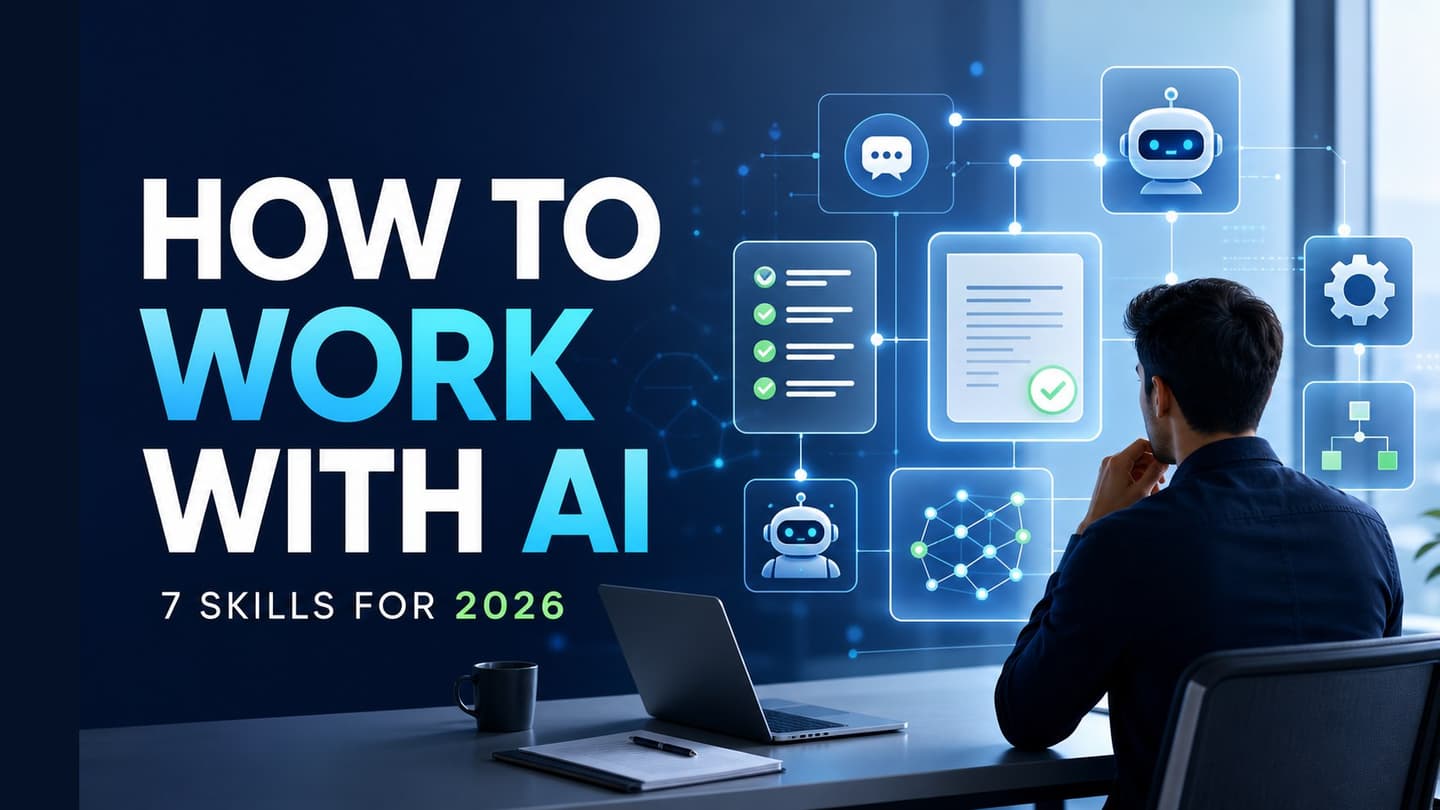
Prompt engineering is not dead. It is just no longer enough
For a while, working well with AI mostly meant knowing how to write a good prompt. In 2026, that still matters, but it is rarely a moat by itself. Models are easier to use, interfaces are better, and the real advantage has moved up a level: from writing clever prompts to designing useful workflows.
The data points in that direction. The World Economic Forum expects 39% of key job skills to change by 2030, with AI and big data, technological literacy, creative thinking, resilience and lifelong learning among the fastest-rising skills. Microsoft’s 2026 Work Trend Index makes a similar point from a workplace angle: advanced AI users do not outsource their thinking. They treat AI output as a starting point, not a final answer.
So the better question is no longer: "How do I write the perfect prompt?" It is: "How do I structure the work so AI improves quality, speed and scale without lowering responsibility?"
These seven skills matter more than prompt engineering alone.
1. Problem framing
AI can accelerate the wrong task very efficiently. If you do not know what problem you are solving, the model will usually give you a polished answer in a vague direction.
Strong AI users start with a brief, not a prompt. Before asking the model for an output, they can name the goal, audience, constraints, quality bar and failure risk.
Useful questions before using AI:
- What outcome do I need?
- Who will use it?
- What must be true for the output to be useful?
- What could go wrong if the model is wrong?
- Do I need an answer, a decision, a list of options, a plan, code or a review?
That is the difference between "write something about AI" and "draft a practical guide for a small business owner who wants to use AI for customer support but is worried about cost, privacy and wrong answers."
The prompt is the wrapper. Problem framing is the map.
2. Context engineering
In the older mental model, the key question was what words you typed into the chat box. In the newer one, the key question is what context the model receives: data, examples, rules, documents, constraints, output format and work history.
Anthropic describes context engineering as the natural progression of prompt engineering. The point is to give the model the smallest high-signal set of information needed for the task, instead of dumping everything into the context window.
In practice, prepare a context pack:
- the goal,
- the audience,
- source material,
- examples of good and bad output,
- what to avoid,
- the desired format,
- the quality criteria.
For longer work, context also needs maintenance. An agent writing a report should not carry the entire messy conversation forever. It should have notes, decisions, assumptions and a current plan. The same is true for humans: if you cannot hand context to a teammate, you probably cannot hand it well to a model either.
3. Workflow decomposition
One big request rarely produces the best result. AI works better when the task is split into stages: research, analysis, outline, draft, critique, revision and final version.
This matters even more with AI agents that can run multi-step tasks. Microsoft describes four modes of working with AI: asking, exploration, collaboration and delegation. The skill is not to delegate everything. It is to know which mode the task calls for.
A simple article workflow:
- AI gathers possible angles and sources.
- The human chooses the thesis and audience.
- AI proposes a structure.
- The human removes weak angles and adds perspective.
- AI drafts the first version.
- AI red-teams the draft by identifying gaps, generic claims and unsupported statements.
- The human decides what stays.
This takes longer than one prompt, but it much more often produces writing, strategy or analysis that can actually be used.
4. Verification and quality control
The most valuable AI skill is not fast generation. It is checking.
Microsoft reports that AI users rank quality control of AI output and critical thinking among the most important human skills as AI takes on more work. McKinsey points in the same direction: high-performing AI organizations are more likely to define when model output needs human validation.
Verification does not mean distrusting everything. It means creating a responsible ritual:
- check facts, numbers and quotations,
- ask the model to list assumptions,
- separate facts from interpretation,
- compare the output against source material,
- use another model or another pass for critique,
- define a scoring rubric before asking for the final version.
Useful follow-up prompts include: "What do you not know?", "What may be missing?", "Which claims need sources?", and "What are the strongest counterarguments?"
In professional work, the winner is not the person who generates the most. It is the person who can turn a fast draft into a reliable result.
5. Managing AI agents
A chatbot answers. An agent acts. That sounds like a small difference, but it changes the whole operating model.
If AI only needs to summarize a text, a good prompt may be enough. If it can search documents, write code, edit files, send messages, create reports or operate tools, you need rules for agent work.
A basic agent operating agreement should define:
- what the agent can do on its own,
- when it must ask a human,
- what data it can access,
- what it must not change,
- how it logs decisions,
- how to stop the process when the result drifts,
- who approves the final output.
LangChain’s State of Agent Engineering report found that quality is the biggest barrier to production agents, while observability and evaluations are becoming standard. That means the future of working with AI will increasingly look like managing a small operating system: observe, evaluate, improve and set boundaries.
6. Data, privacy and cost awareness
AI is not only a creative tool. It is infrastructure that consumes data, tokens, energy, time and budget.
In 2026, you should be able to answer basic questions:
- Can I paste this data into an external tool?
- Does the material contain personal data, company secrets or client information?
- Do I need a frontier model, or is a cheaper model enough?
- Should this run locally, in a company environment or in a public app?
- What does the automation cost if it runs 1,000 times?
The NIST AI Risk Management Framework encourages organizations to think through AI with four functions: govern, map, measure and manage. For an individual worker, that translates into a simple habit: know the risks, understand the context, measure quality and respond when the system no longer fits the goal.
In the European Union, AI literacy is no longer just a nice phrase. The European Commission notes that Article 4 of the AI Act requires providers and deployers of AI systems to ensure a sufficient level of AI literacy for staff and others using AI systems on their behalf.
7. Thinking with AI, not instead of AI
The biggest risk is not that AI sometimes gets things wrong. The bigger risk is that people stop thinking because the model sounds confident.
MIT Media Lab described a study where AI helped participants detect fake news during assisted sessions, but after several weeks their unassisted performance declined. The lesson is simple: AI can be a coach or a crutch. If it only gives answers, it can create dependency. If it asks questions, shows criteria and pushes for justification, it can strengthen thinking.
Change the way you ask:
- instead of "write it for me," ask "help me find a stronger structure",
- instead of "is this true?", ask "how should I verify this?",
- instead of "give me the answer," ask "give me three hypotheses and ways to test them",
- instead of "improve this text," ask "what is unclear, unsupported or too generic?"
AI is at its best when it expands your thinking rather than replacing it.
A simple AI workflow
Use this seven-step workflow for almost any serious task:
- Define the outcome: what should exist, and how will you know it is good?
- Build the context: add sources, audience, constraints and examples.
- Choose the mode: asking, exploration, collaboration or agent delegation.
- Generate a draft: not the final answer, just a working version.
- Verify: facts, sources, numbers, assumptions and risks.
- Decide as a human: keep responsibility for the result.
- Save the lesson: turn a good process into a reusable template.
That is more useful than a list of magic prompts. Prompts change. Workflows compound.
The shortest rule
In 2026, a strong AI user is not the person with the most prompting tricks. It is the person who can define work clearly, give the model the right context, verify the output, manage agents and take responsibility for decisions.
Prompt engineering is one layer. The deeper skill is AI workflow literacy: designing how people and models work together so the result is faster, better and safer.
Related concepts: prompt engineering, AI agent, AI governance, AI hallucination, model evaluation.