Technical AI
What is physical AI? Humanoid robots explained
Humanoid robots are moving from laboratories into factories and warehouses. This guide explains physical AI, robot learning and the use cases that make practical sense.
The short answer
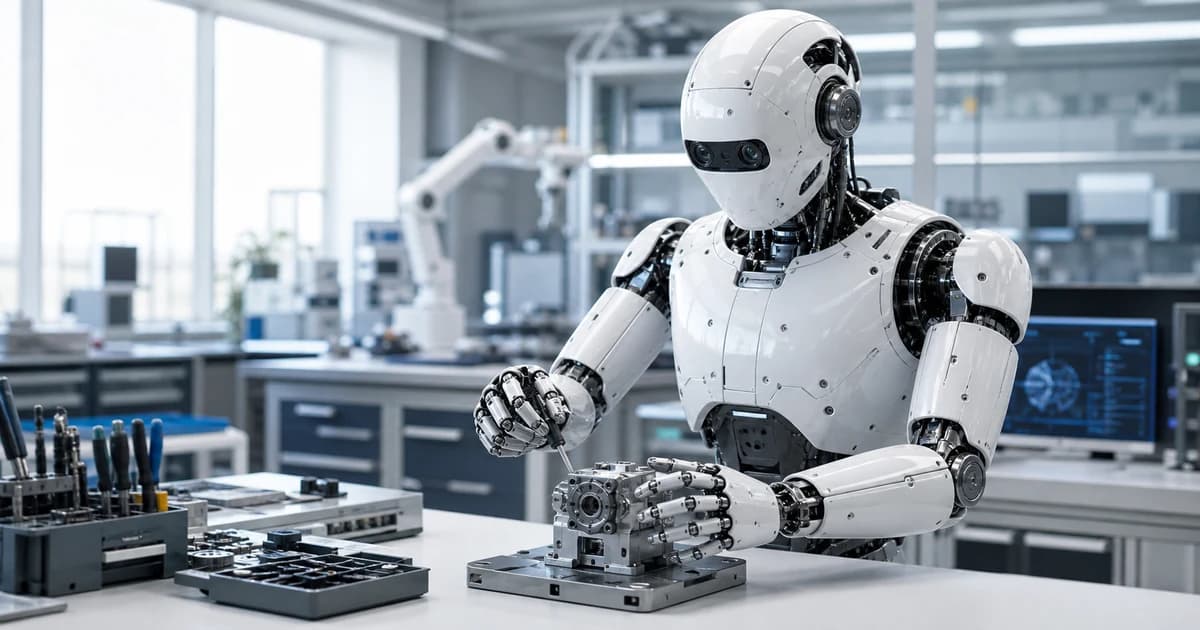
Physical AI describes artificial intelligence that can perceive, understand and act in the physical world. Instead of producing only text, images or code, a physical AI system turns sensor data and instructions into actions performed by a robot, vehicle or autonomous machine.
A humanoid robot is one possible body for that intelligence. It is usually built with a torso, two legs, arms, hands, cameras and other sensors so it can work in environments designed for people. The human shape alone does not make a robot intelligent. Its usefulness comes from the combination of mechanics, perception, control and AI models that can translate observations into safe movement.
The important change is not that robots can walk more smoothly in demonstrations. New systems are beginning to:
- identify objects and people in changing environments,
- interpret instructions expressed in natural language,
- learn from human demonstrations and simulation,
- plan multi-step tasks,
- improve from data collected across a robot fleet.
That combination is what is pushing humanoids from research projects toward early commercial work.
Physical AI versus generative AI
Generative AI mainly manipulates information. It writes a paragraph, produces an image, generates software or synthesizes audio. Physical AI has to understand space, predict the consequences of movement and execute a decision through a real machine.
The difference raises the stakes. A language model can produce an incorrect sentence. A robot making a comparable error may drop a component, damage equipment or endanger a person. Physical AI therefore combines machine learning with robotics, control systems, simulation, mechanical engineering and independent safety layers.
The term is broader than humanoid robotics. Physical AI also includes:
- autonomous vehicles and mobile robots,
- industrial arms controlled by learned models,
- warehouse and delivery systems,
- semi-autonomous construction equipment,
- vision systems that trigger a physical response rather than merely reporting a result.
Humanoids are the most visible example, but they are not always the best machine for the job. A conveyor belt is a better answer than two legs and ten fingers when the task never changes.
Why build a robot in the shape of a person?
Factories, warehouses, offices and homes were designed around the human body. They contain stairs, door handles, shelves, tools and workstations that assume human reach and dexterity. A humanoid is meant to enter that environment without requiring every building and process to be rebuilt.
The form factor offers four potential advantages:
- Mobility and reach. A robot can move between work areas, approach a shelf and handle objects at different heights.
- Compatibility with human tools. Arms and hands can operate containers, carts, doors and equipment already used by workers.
- Task flexibility. The same platform may eventually move between several tasks instead of repeating one fixed motion.
- Deployment in existing spaces. Companies can test automation without immediately constructing machine-only infrastructure.
That flexibility is expensive. A biped must balance, coordinate many joints, conserve battery power and react safely to contact. A purpose-built machine will often be faster, cheaper and more reliable.
A useful reality check: walking across a stage can be easier than picking one soft shirt out of a laundry basket. Fabric changes shape, hides parts of itself and rarely presents the same grasp twice. Everyday tasks that look trivial to people can be extremely difficult for robots.
How a humanoid robot works
There is no single component that serves as the complete “robot brain.” A useful humanoid is a stack of systems operating at different speeds.
1. Perception: sensing the world
RGB cameras, depth cameras, tactile sensors, microphones, joint encoders and inertial measurement units provide information about the environment and the robot's own body. Computer vision helps locate objects, people, obstacles and free space.
Recognizing that an object is a cup is not enough. The system must estimate its position, orientation, material and possible grasp points. It also needs to notice when a hand blocks the camera or when the object begins to slip.
2. Understanding and planning
Multimodal models combine visual input, language and sensor data. An instruction such as “put the blue box on the lower shelf” can then be decomposed into smaller steps:
- identify the correct box,
- determine a path to it,
- choose a stable grasp,
- lift the object,
- move to the shelf,
- find an open space,
- place the box and verify completion.
One important direction is the vision-language-action model, or VLA. It connects images and language to the actions a robot should perform. A conventional multimodal model may describe a scene; a VLA model is trained to produce movement.
3. Whole-body control
A high-level plan must become thousands of small motor corrections. Controllers manage balance, foot placement, grip force, arm trajectories and joint limits. Many of these decisions have to happen faster than a large cloud model could respond.
Humanoids therefore combine slower reasoning with fast learned policies and conventional control systems. One layer chooses a goal, while another reacts immediately to slipping, loss of balance or an unexpected obstacle.
4. Action and feedback
Motors and actuators move the machine, but the system continuously checks the result. If a box is heavier than expected, the grasp must change. If a person enters the planned path, the robot should slow down or stop.
This closed loop — observe, decide, act and observe again — is the foundation of physical intelligence.
How robots learn new tasks
Programming every movement by hand does not scale to thousands of objects and unpredictable conditions. Robotics teams combine several learning methods.
Human demonstrations
An operator performs a task through teleoperation, controllers or motion capture. The system records examples of approaching an object, grasping it, avoiding obstacles and completing the job. A model learns the pattern and then attempts to handle variations.
Simulation and synthetic data
A virtual factory can repeat one situation thousands of times while changing lighting, object weight, floor friction and obstacle placement. A simulated robot can fall repeatedly without damaging hardware or stopping a production line.
World models help predict what may happen after an action. They give a system a way to evaluate possible futures before moving a physical arm. Like other foundation models, they can provide a reusable base that is later adapted to multiple tasks. NVIDIA describes this combination of simulation and world foundation models as a way to generate training data and test robot policies before deployment.
Reinforcement learning
A model receives a reward for completing a goal and a penalty for undesirable behavior. This can teach walking, balance and manipulation. The difficult part is defining the objective: a robot should not finish faster by ignoring safety, dropping an object or using excessive force.
Fleet data
Real deployments reveal edge cases that a laboratory misses. Data from many machines can expose rare faults, difficult surfaces and unexpected human behavior. A validated model update can then improve an entire fleet, although this requires careful data governance, testing and staged deployment.
Where humanoid robots make sense today
The most credible use cases do not yet look like a universal home assistant. They are repetitive, measurable and located in relatively controlled environments.
| Area | Example tasks | Why a humanoid may fit |
|---|---|---|
| Logistics | moving totes, unloading, order handling | warehouses use aisles, shelves and containers designed for people |
| Manufacturing | feeding parts, tending stations, inspection | one robot can potentially move between existing process steps |
| Facility operations | inspection, reading gauges, simple service work | tasks require mobility and different tools |
| Hazardous environments | heat, chemicals or structural risk | a machine can reduce human exposure |
| Research and education | manipulation, control and human-robot interaction | a shared platform avoids rebuilding hardware from scratch |
A strong deployment candidate is physically demanding, repetitive and valuable enough to justify integration. “Help with anything” is not a useful specification.
Leading humanoid platforms in 2026
The market changes quickly, so this is not a permanent ranking. The table shows several approaches to the same challenge.
| Platform | Primary direction | What matters |
|---|---|---|
| Boston Dynamics Atlas | industrial manufacturing | the electric Atlas has entered a product phase, with 2026 deployments scheduled at Hyundai and Google DeepMind |
| Agility Robotics Digit | logistics and manufacturing | Digit is commercially deployed for tote handling, with deployments also offered through Robots-as-a-Service |
| Figure 03 | logistics, industry and eventually the home | the platform is designed around Figure's Helix VLA model and higher-volume production |
| Unitree G1 and H2 | research, development and demonstrations | G1 lowers the hardware entry price, while H2 provides the body for NVIDIA's open reference design |
| NVIDIA Isaac GR00T Reference | physical AI research | the open reference combines a Unitree body, dexterous hands, Jetson Thor compute and the GR00T software stack |
The NVIDIA Isaac GR00T Reference Humanoid Robot, announced on May 31, 2026, matters because it attempts to standardize the research workflow. It connects hardware, data capture, simulation, training, evaluation and on-robot deployment instead of forcing every team to assemble the full stack independently.
This could do for robotics what common development platforms did for mobile applications and generative AI. It does not remove the need for good hardware or a well-defined task, but it may reduce duplicated infrastructure work.
How much does a humanoid robot cost?
There is no single honest answer. Pricing depends on whether the buyer needs a demonstration platform, a research kit, an industrial system or a managed service that includes integration and maintenance.
Unitree publicly advertises the G1 from $13,500, while its online store has listed a base configuration at roughly $16,000 before shipping, tax and import costs. It is one of the few public reference points. Research editions with better hands, development access and additional compute cost more.
Industrial platforms such as Atlas, Digit and Figure generally do not have a simple retail price. They are sold through deployments, pilot programs or Robots-as-a-Service contracts.
Hardware is only part of the total cost. A buyer also needs to consider:
- workflow and software integration,
- task data and training,
- hands, grippers, sensors and additional compute,
- safety engineering,
- charging, maintenance and spare parts,
- operator supervision,
- downtime and software updates.
The better question is not “How much is the robot?” but “What is the full cost of completing one useful task over the system's operating life?”
How to separate deployment from demonstration
A video showing one successful attempt says little about product readiness. Ask more specific questions:
- Was the task autonomous or teleoperated?
- How many attempts succeeded without editing?
- How long can the robot work on one charge?
- What happens after a failed grasp or blocked path?
- How quickly does the system recover from an error?
- Is it running inside a real process or a prepared demonstration area?
- How are the fleet, spare parts and software updates managed?
- What is the cost of one productive operating hour?
Reliability data matters more than spectacle: completed cycles, uptime, human interventions, recovery time and maintenance cost. An athletic demonstration can prove excellent motion control without proving that the machine can work a ten-hour warehouse shift.
Safety matters more than the “wow” factor
A robot working near people must be designed on the assumption that an AI model will occasionally be wrong. Safety cannot depend only on the model's judgment.
A production system needs:
- mechanical and software limits on force and speed,
- an emergency stop accessible to people,
- collision detection and protected zones,
- independent controllers for safety-critical parameters,
- a safe-stop mode after communication or power faults,
- access control and signed software updates,
- logs covering actions, faults and interventions,
- a risk assessment for the specific workplace.
The more general the model becomes, the more important the constraints it cannot override. A language instruction should never disable a force limit, enter a forbidden zone or rewrite its own safety policy.
Will humanoid robots replace workers?
In the near term, robots are more likely to replace tasks than complete occupations. A humanoid may move containers while people continue to design the process, supervise the fleet, handle exceptions, maintain equipment and make accountable decisions.
The first tasks to be automated will usually be:
- repetitive,
- physically demanding or hazardous,
- performed in a structured environment,
- easy to measure,
- expensive because of labor shortages or high turnover.
Work requiring improvisation, responsibility, social interaction and operation in unpredictable places will remain much harder. Progress will also be uneven. A robot may become excellent at handling one standardized tote while still failing inside a cluttered kitchen.
A practical deployment checklist
Before starting a humanoid pilot:
- Select one task, not a general automation vision.
- Measure the current process: time, cost, errors, injuries and downtime.
- Check simpler machines: a conveyor, autonomous cart or fixed arm may be the better answer.
- Define exceptions: what happens with a damaged package or blocked route?
- Set autonomy boundaries: when is human approval or intervention required?
- Calculate total cost, not just the hardware price.
- Start in a small zone and expand only after collecting reliable data.
A humanoid wins when flexibility and compatibility with human spaces justify its additional complexity. It should not be selected merely because it looks more futuristic.
What changed in 2026
Three developments suggest that the market is maturing:
- Robots are moving from prototypes to deployments. Atlas is entering its first facilities, Digit is expanding commercial agreements and Figure is scaling its next generation.
- Models are becoming more general. VLA models and world models aim to support many tasks instead of requiring a separate program for every action.
- Shared infrastructure is emerging. NVIDIA is combining open GR00T models, Isaac simulation and a reference humanoid to shorten the path from an experiment to validation on real hardware.
Manufacturers are moving in the same direction. Hyundai is connecting robotics and physical AI as it prepares industrial use cases for Boston Dynamics humanoids. This does not mean a mass market for home robots has arrived. It means the sector is increasingly judged by productivity, reliability and cost rather than demonstrations alone.
Frequently asked questions
Does every humanoid robot use artificial intelligence?
No. A robot can execute programmed sequences without an advanced AI model. AI becomes valuable when the machine needs to perceive a changing environment, learn a task, interpret instructions or select actions autonomously.
What is the difference between physical AI and embodied AI?
The terms overlap. Embodied AI emphasizes intelligence situated in a body and learning through interaction. Physical AI is often used more broadly for autonomous vehicles, robots and intelligent industrial machines that perceive and act in the physical world.
Can you buy a humanoid robot today?
Yes, selected research and demonstration platforms are commercially available. That does not mean buyers receive a finished general-purpose helper. Useful deployment may require additional hardware, custom software, integration and a controlled operating environment.
When will humanoid robots enter homes?
Early and expensive pilots already exist, but a general home robot still has to overcome reliability, safety, cost and the enormous variability of household objects. A factory or warehouse is a much easier first market than an unpredictable home.
Is a humanoid better than an industrial robot arm?
Not by default. A fixed arm is usually better for a fast, repetitive task in one place. A humanoid becomes interesting when the machine must move between locations, use different workstations and operate in an environment designed for people.
What this guide will track
This is an evergreen guide. As the market develops, we will update:
- platform availability and pricing,
- verified commercial deployments,
- progress in VLA models and world models,
- reliability and operating-time data,
- regulation and safety standards,
- practical recommendations for companies and research teams.