NVIDIA RTX Spark: Windows PCs Are Being Rebuilt for Local AI Agents
NVIDIA and Microsoft have unveiled RTX Spark, a new Windows PC platform for local AI agents, large models and creative workflows. The bet is simple: personal computers need to become machines that can run serious AI locally, not just connect to cloud chatbots.
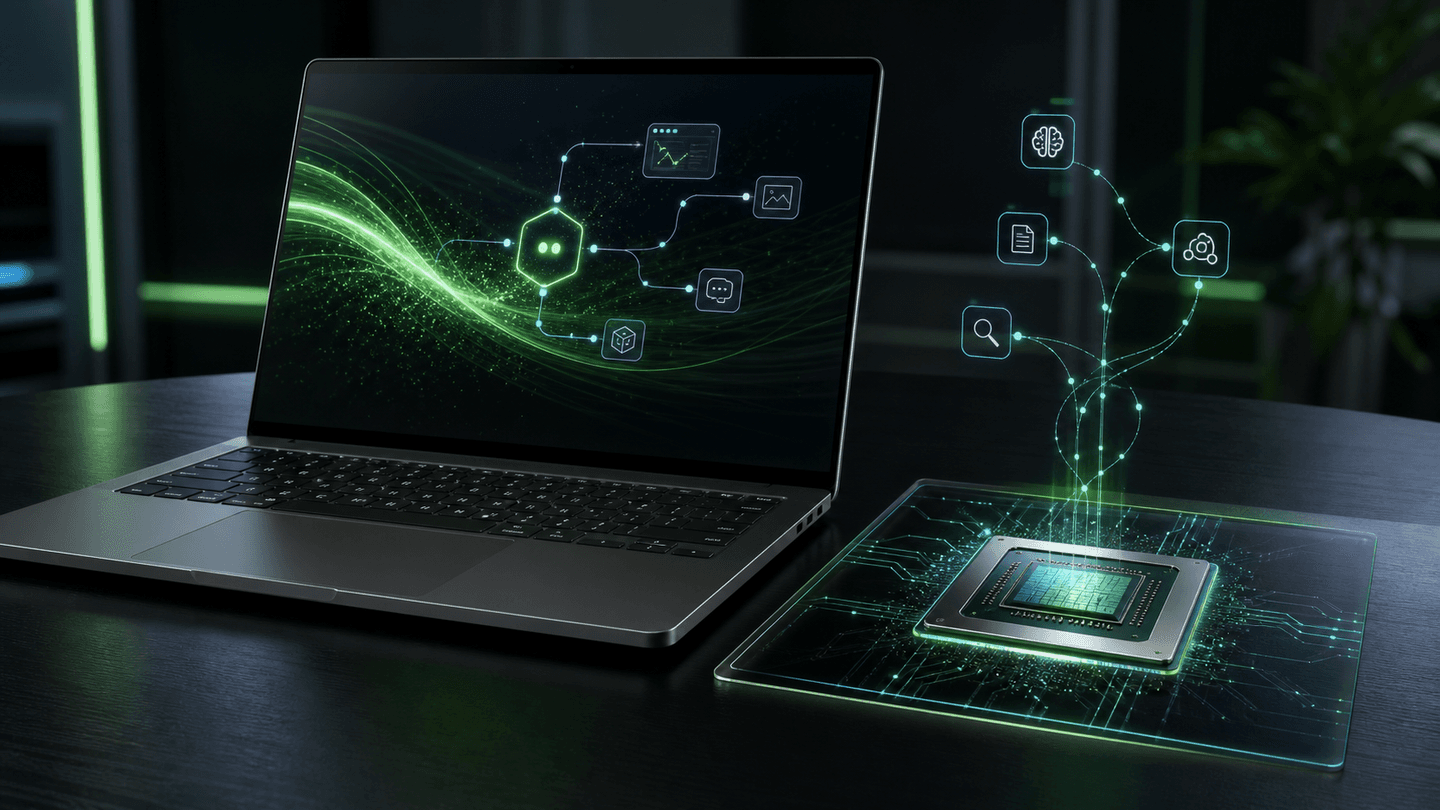
NVIDIA and Microsoft have unveiled RTX Spark, a new platform for Windows laptops and compact desktops designed around local AI agents. This is not just another "AI PC" badge. At least in ambition, it is an attempt to make the personal computer useful for something more serious than forwarding prompts to a cloud model.
The announcement landed on May 31, 2026, around NVIDIA GTC Taipei and Computex. According to NVIDIA, RTX Spark-powered thin laptops and compact desktops are expected this fall from ASUS, Dell, HP, Lenovo, Microsoft Surface and MSI, with Acer and GIGABYTE systems to follow.
The bigger story is not the chip alone. It is the idea that the PC is being redesigned for agents that can work with local files, code, media and applications while keeping more data on the device. If that works, the laptop stops being a thin terminal for cloud AI and becomes a local AI workstation you can actually carry.
What RTX Spark Actually Is
RTX Spark is a superchip that combines CPU and GPU capabilities in a single Windows PC platform. The headline specifications are aggressive:
- up to 1 petaflop of FP4 AI performance,
- up to 128 GB of unified memory,
- up to 6,144 Blackwell RTX GPU cores,
- up to 20 Arm-based efficient CPU cores,
- native access to NVIDIA's CUDA, RTX, TensorRT, DLSS and broader AI software stack.
Microsoft says in the Windows Experience Blog that Windows has been optimized for this heterogeneous architecture. That includes workload scheduling across the CPU cores, power and thermal management, Windows ML support for TensorRT and better handling of large unified-memory systems.
That memory point matters. Local AI is often limited less by raw compute than by memory. Large language models, video generation, high-resolution diffusion workflows and big 3D scenes can all hit memory ceilings quickly. A system with up to 128 GB of unified memory lets the CPU and GPU work from the same large pool instead of constantly moving data across separate memory spaces.
Why Local Agents Need a Different Kind of PC
Most AI-agent demos still rely heavily on the cloud. The agent plans, clicks, writes code, searches documents, generates images or automates a workflow, but much of the intelligence runs somewhere else. That is convenient, but it is not always acceptable.
Local agents have three obvious advantages:
- Privacy: documents, notes, local files and some prompts can remain on the device.
- Responsiveness: many tasks can run without a network round trip.
- Cost control: some work can happen without metering every token or remote GPU minute.
NVIDIA is framing RTX Spark as hardware for agents that run on the user's primary device. The company gives examples such as agents executing tasks in Windows apps, reasoning across applications, generating images and video, coding plug-ins and apps, and semantically searching local files.
That is a very different computer from the classic app launcher. It is a machine where the agent has context. That is also why this announcement is both exciting and risky.
Security Is the Real Test
The most important part of the announcement may not be performance. NVIDIA and Microsoft are also talking about new Windows security primitives and NVIDIA OpenShell, a runtime layer intended to give users policy control over what agents can and cannot do.
That is not a footnote. If an agent can read files, move through apps and perform work on behalf of a user, it cannot be treated like a normal chatbot in a browser tab.
The hard questions are practical:
- Which files is the agent allowed to read?
- Can it send private context to a cloud model?
- How does the user approve actions across applications?
- What gets logged?
- How quickly can the user stop an agent that misunderstood the task?
This is where the phrase "PC as teammate" either becomes useful or collapses into risk. Compute alone does not make local agents trustworthy. They need containment, identity, policies and visible control.
Creative Workflows Are a Big Part of the Pitch
RTX Spark is not only aimed at AI developers. NVIDIA is also pitching creators: video editing, image generation, 3D scenes, rendering and Adobe workflows. The company says RTX Spark systems can handle workloads such as 90 GB 3D scenes, 12K 4:2:2 video editing, 4K AI video generation and 120B-parameter local language models with very long context.
That needs some healthy skepticism. "Can run" does not always mean "will feel great in every real project." Actual performance will depend on the device, power limits, thermals, memory configuration, drivers and application support.
Still, the direction is clear. NVIDIA wants local AI to move beyond terminal demos and developer workstations. It wants RTX Spark inside familiar premium PCs, from Surface to XPS, Yoga, OmniBook, ProArt and compact desktops.
That could matter because adoption often starts when hardware stops feeling exotic. A local AI workflow becomes much easier to sell when it arrives in the same laptop families that creators and developers already buy.
A Direct Challenge to the PC Silicon Order
RTX Spark is also strategically important because NVIDIA is moving deeper into territory dominated by Intel, AMD, Apple and Qualcomm. For many PC buyers, NVIDIA has been the GPU company. RTX Spark lets NVIDIA tell a larger story about the whole machine.
Microsoft has its own reason to care. Windows needs a strong answer to the Apple Silicon narrative: large unified memory, efficient performance, serious local media workflows and increasingly credible on-device AI. It also needs to prove that "AI PC" means more than a small NPU and a few Copilot features.
RTX Spark is trying to raise that bar. The promise is a PC that can run serious local models, creative pipelines and agent workflows. That is a big promise, and it will have to survive real devices.
What to Watch This Fall
The important test will not be the launch deck. It will be what happens when RTX Spark laptops and desktops reach users.
First: price. If the first systems land only in the most expensive premium tier, the platform may be impressive but slow to matter.
Second: battery life and noise. A local AI agent sounds great until the laptop gets hot and loud after a few minutes of real work.
Third: applications. Specs alone are not enough. Users need visible workflows: coding, local search, asset generation, video editing, research and app automation.
Fourth: security. Agents in the Windows taskbar will only make sense if users can understand permissions, review actions and limit what the agent can do.
Fifth: the cloud boundary. The best future is not purely local or purely cloud. It is a system that knows what should stay private on the device and what can be routed to a larger model when needed.
Bottom Line
RTX Spark is easy to dismiss as launch language. "The PC becomes a teammate" sounds like a keynote phrase. But underneath the marketing is a real shift: local AI needs a different class of personal computer, and NVIDIA and Microsoft are trying to define it before the market settles.
The cloud is not going away. Frontier models, large-scale training and heavy inference will still live there. But the local layer is becoming more important. It is where private context lives, where latency matters, and where everyday work actually happens.
If RTX Spark systems deliver on performance, battery life, thermals and security, Windows could get its most interesting hardware story in years. The personal computer would not just run apps. It would start running useful agents beside them.