Edge AI vs cloud: how to choose infrastructure
Compare local processing, edge AI and cloud infrastructure across latency, privacy, cost, scaling and the operational work required to run AI systems.
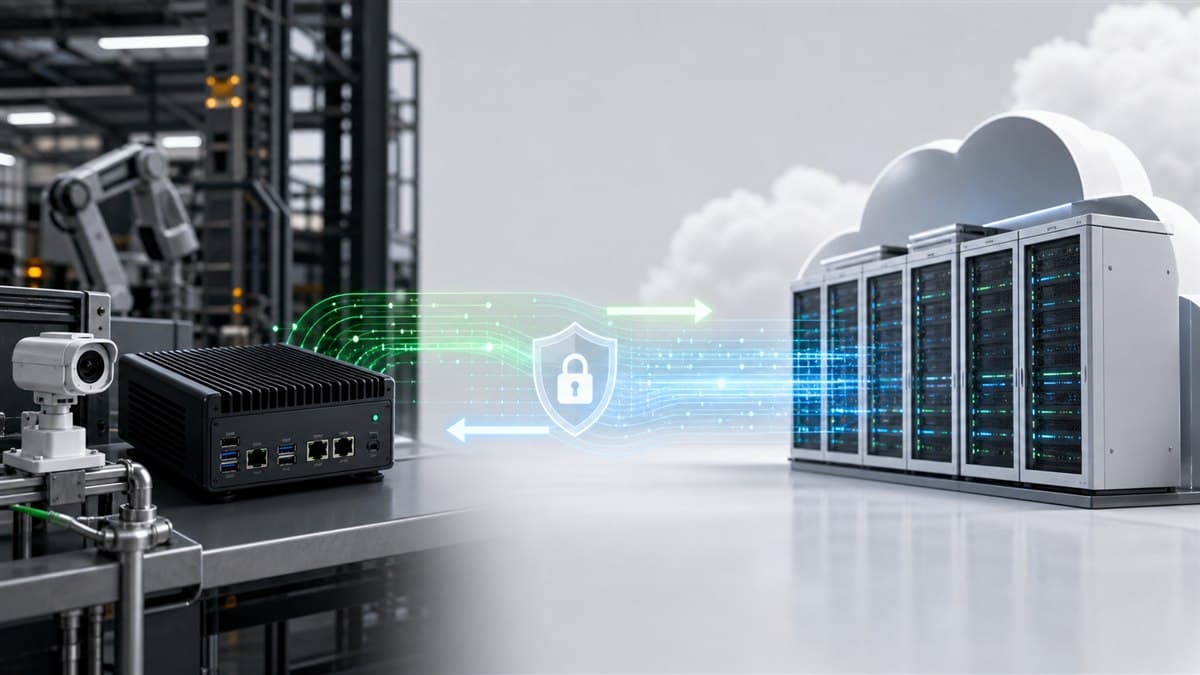
An AI model can run in a data center, on a company server, on a user's computer or directly inside the device collecting data. The inference location affects latency, privacy, cost and the reliability of the entire product.
There is no universally best architecture. A consumer chat service, an industrial camera and a document assistant for a law firm have fundamentally different requirements.
What edge AI means
Edge AI performs inference close to where the data is created: in a camera, vehicle, phone, industrial gateway or local computer. Data does not have to travel to a distant data center for every decision.
“Edge” does not always mean a tiny processor inside a sensor. It can also be a server installed in a factory, retail location or regional office.
The AWS guide to real-time intelligence at the edge provides additional examples of deployment patterns and constraints.
The main differences
| Criterion | Edge or local | Cloud |
|---|---|---|
| Latency | usually lower and predictable | depends on network and region |
| Privacy | data may remain on the device | data is sent to a provider |
| Scaling | requires fleet management | resources can scale centrally |
| Updates | distributed and harder | deployed in one environment |
| Models | constrained by local hardware | access to large accelerators |
| Offline use | possible | usually limited |
| Cost | hardware purchased upfront | usage and transfer charges |
When edge AI has an advantage
The response must be immediate
A robot, vehicle or quality-control system cannot wait for a cloud round trip before every decision. Local inference reduces latency and dependency on connectivity.
The data is sensitive
Camera footage, voice recordings or medical documents can be processed locally, with only a result or anonymized data sent to a central system.
Connectivity is unreliable
Field equipment, industrial sites and vehicles should preserve essential functions even when an internet connection disappears.
The workload is continuous
For steady, predictable use, a local accelerator may eventually produce more stable costs than constant cloud calls.
When the cloud wins
You need a very large model
The largest models require accelerators and memory that cannot be placed economically in an endpoint device.
Traffic changes rapidly
Cloud platforms are better suited to campaigns, sudden user growth and seasonal demand. Hardware does not have to be installed in every location ahead of time.
The model changes frequently
Central deployment simplifies updates, A/B tests, monitoring and rollback of a faulty release.
The team does not want to manage hardware
Cloud services shift part of the responsibility for accelerators, networking and availability to the provider, although the customer still owns cost control, data governance and configuration.
Hybrid architecture is often the practical answer
The decision does not have to be binary. A system can:
- detect objects locally and analyze trends in the cloud,
- use a small model on the device and escalate difficult cases,
- anonymize data before transmission,
- queue work offline and synchronize later,
- run safety-critical functions locally and reporting centrally.
This design can reduce bandwidth and latency without giving up larger models and centralized management.
Questions to ask before choosing
- What is the maximum acceptable response time?
- Must the product work without an internet connection?
- Which data may leave the device or organization?
- How often will the model be updated?
- How many devices must be managed?
- Is demand steady or highly variable?
- What happens when the cloud or device fails?
- How will model quality be measured after deployment?
Operations still matter
On-device inference does not eliminate operational work. It needs secure updates, model versioning, temperature and performance monitoring, and a reliable rollback path.
The cloud makes centralized metrics easier, but costs can grow through autoscaling, long contexts, data transfer and idle instances.
How to make the decision
Build two small prototypes and compare them on real data. Measure the full time from input to result, cost per task, behavior during network loss and the engineering effort needed to maintain each design.
The best infrastructure is not the environment that runs the largest model. It is the one that meets the product requirements at an acceptable cost and risk.