Noam Shazeer Leaves Google for OpenAI in a Major AI Talent Move
Noam Shazeer, a co-author of the Transformer paper and former Character.AI co-founder, is leaving Google for OpenAI. The move is one of the loudest signals yet in the AI talent war.
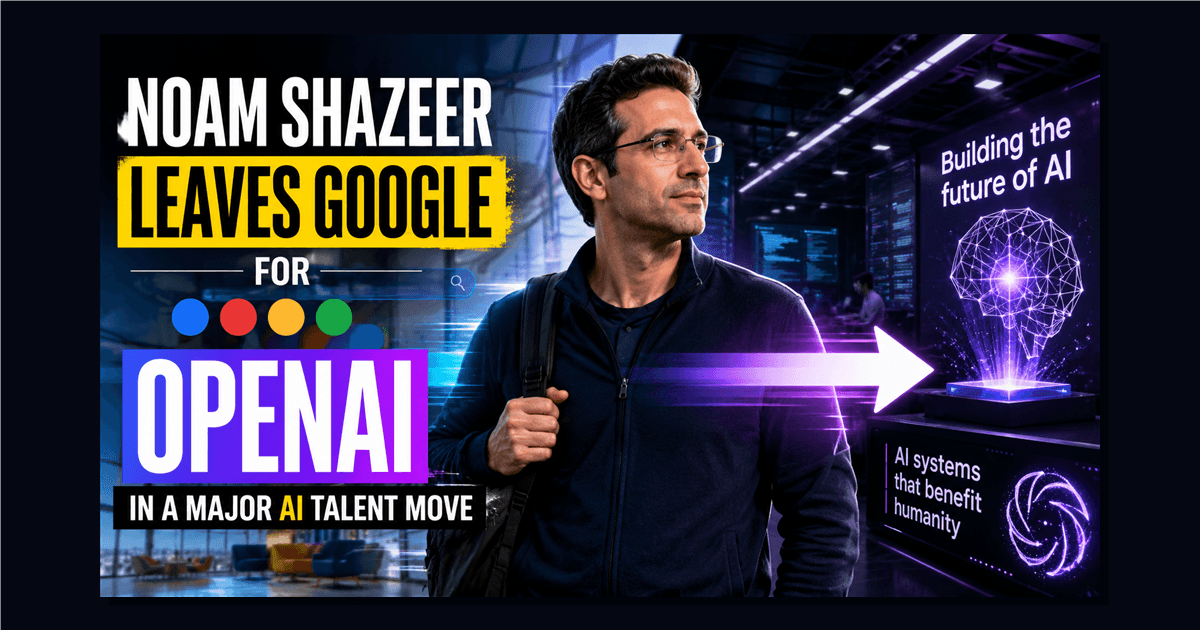
Noam Shazeer, one of the most influential researchers in modern artificial intelligence, is leaving Google to join OpenAI. The move was reported by Axios and Business Insider. This is not an ordinary executive shuffle. In the world of language models, Shazeer is associated with technologies that sit close to the foundation of the current AI wave.
The short version: OpenAI is gaining a researcher who co-authored the Transformer paper, worked on large-scale language models before they became mainstream products, co-founded Character.AI and later returned to Google to help lead Gemini. For Google, it is a loss of experience and prestige. For OpenAI, it is a sign that the frontier AI race is being fought not only with models, products and compute, but also with the people who know how to design the next generation of systems.
What you need to know
- Shazeer is moving from Google to OpenAI less than two years after returning from Character.AI.
- Media reports have put Google's Character.AI-related deal at around $2.7 billion.
- He co-authored Attention Is All You Need, the paper that introduced the Transformer architecture.
- He also worked on Mixture-of-Experts scaling, including the paper Outrageously Large Neural Networks.
- The move highlights a simple truth: in AI, frontier talent can be as strategic as GPUs.
Who Noam Shazeer is
Noam Shazeer joined Google in 2000. He worked on search-related technologies in the company's early years and later became one of the important figures in Google's language-model research. His name is especially tied to 2017, when Attention Is All You Need introduced the Transformer architecture. That architecture became the basis for models such as GPT, Gemini, Claude, Llama and many open-weight LLMs.
It is hard to overstate the paper's influence. Transformers made sequence modeling more parallelizable and scalable than earlier approaches built primarily around recurrent networks. When people now talk about large language models, context windows, tokens, fine-tuning or AI agents, they are often still talking about systems built on the same architectural family.
Shazeer was not only a co-author of one famous paper. In 2017 he also led work on sparsely-gated Mixture-of-Experts. That direction later became one of the most important ways to scale models: instead of activating every parameter for every token, the model routes computation through selected experts. Today, different variants of MoE appear across many large-model families because they promise more capacity without a proportional increase in serving cost.
Character.AI, Google and the billion-dollar return
The striking part of the story is that Shazeer had already left Google once. In 2021, he co-founded Character.AI with Daniel De Freitas. The service let users chat with customizable AI characters and quickly attracted attention, users and investors. But like many AI startups trying to build their own models, Character.AI also faced the harsh economics of training: compute, data and research teams are expensive at frontier scale.
In 2024, Google entered into an unusual arrangement with Character.AI. According to Axios, the company's co-founders and more than two dozen researchers returned to Google, while Google received a non-exclusive license to Character.AI's technology. Character.AI was not acquired in the conventional sense and remained a separate company, but the signal was clear: the biggest AI labs were willing to pay extraordinary sums to bring key people back inside.
Shazeer's new move makes that arrangement look less permanent than it may have seemed. If the most valuable part of a deal is human judgment, even a very expensive contract does not turn that person into a durable corporate asset. Axios framed this as one of the limits of acqui-hire-style deals: retention can buy time, but it cannot guarantee where a top researcher will work next.
What OpenAI gains
OpenAI is gaining more than a famous name. It is gaining a researcher with experience across three layers of modern AI: model architecture, scaling strategy and the product reality of conversational systems. That mix is rare. Some researchers have deep academic depth, some builders understand product, and some engineers know the training stack. Shazeer has worked across all of those worlds.
For OpenAI, that could matter when designing future generations of models. This does not mean one person will single-handedly deliver the next breakthrough. Frontier systems are built by large teams, enormous infrastructure and long evaluation loops. But at this level, architectural decisions can shift cost, capability and development speed across the whole organization.
The analogy is not perfect, but it helps: this is a bit like a racing team hiring an engine designer. The driver, pit crew and factory still matter, but someone who knows where to find a few percentage points of performance can be worth more than another layer of marketing.
What Google loses
Google does not stop being an AI powerhouse because one person leaves. It still has TPU infrastructure, DeepMind, large research teams and products used by billions of people. Gemini remains one of the most important model families in the market, and Google has unusual distribution advantages through Search, Android, Workspace, YouTube and Cloud.
Symbolically, however, the loss is significant. For years, Google has been seen as a place where important AI ideas are born, but not always the place where they reach users first. The Character.AI story reflected that tension: researchers building conversational systems left to ship faster. Shazeer's return in 2024 looked like a correction. His departure now is a reminder that history alone does not secure the future.
The move may also increase internal pressure. Google needs to show that Gemini is not merely responding to ChatGPT, but advancing on its own timetable. Losing a co-lead does not imply technical collapse, but perception matters in the AI race. Investors, developers and users watch not only benchmark scores, but also where the field's most important people choose to work.
Why the AI talent war is so expensive
In conventional software, a single engineer rarely changes an entire category. AI is different because the number of people who have actually designed, trained and debugged frontier-scale models is still limited. Experience with model architecture, training dynamics, data quality, alignment behavior and inference economics cannot be bought like a commodity.
That is why the major labs now compete with several tools at once:
- very large compensation packages,
- quasi-acquisitions of startups,
- technology licenses tied to team hiring,
- access to massive compute clusters,
- the promise of working on models that reach hundreds of millions of users.
Shazeer fits perfectly into that landscape. His arrival at OpenAI may not immediately translate into a visible ChatGPT feature, but it could influence research direction, architectural priorities and the speed of internal experiments.
What we still do not know
At this point, there is no complete public description of Shazeer's role at OpenAI or the exact project he will work on. It is reasonable to expect his experience to be especially valuable in model architecture and scaling, but the details of OpenAI's roadmap remain private. It is also not clear whether the move was connected to the end of a retention period after the Character.AI arrangement or to other factors.
There is also no reason to declare Gemini technically weakened overnight. Large AI programs do not depend on one person. The more useful question is whether this is an isolated move or the start of a broader pattern: further departures, internal reorganization at Google or a visible acceleration at OpenAI.
The bigger takeaway
Noam Shazeer's move matters not because it single-handedly decides the rivalry between Google and OpenAI. It matters because it shows what the current stage of the AI race looks like. Companies are no longer competing only on parameter counts, context windows or benchmark charts. They are competing for the people who know how to move the frontier one step further.
For readers tracking AI, this is a useful reminder to look beyond model launch headlines. Talent moves often reveal where the industry expects the next breakthroughs to happen. If one of the authors of the Transformer paper decides his next stop is OpenAI, competitors will notice.