Claude Opus 4.8 Is Here: A Quiet Upgrade for AI Agents and Serious Coding
Anthropic has launched Claude Opus 4.8. This is not a flashy demo release, but a practical upgrade for coding, agents and knowledge work: stronger benchmarks, better honesty, dynamic workflows and unchanged regular pricing.
Anthropic has released Claude Opus 4.8, and the most interesting part is not that the benchmark bars moved up. The real story is that Anthropic is pushing Opus from "smart model" toward "collaborator you can leave alone with a hard task for longer."
That distinction matters. When AI acts as an agent, writes code, uses tools, reads documents and returns after a long run, the main risk is not that it lacks cleverness. The main risk is confident progress without evidence.
Opus 4.8 is aimed directly at that pain point: stronger coding, steadier long-running work, better tool use and more willingness to flag uncertainty instead of silently declaring victory.
What Anthropic Actually Shipped
Claude Opus 4.8 succeeds Opus 4.7 and is available across Claude, Claude Code, the API and major cloud platforms. The API identifier is claude-opus-4-8.
For the product itself, see our evergreen Claude Code guide covering installation, sandboxing and reliable workflows.
The useful launch details:
- Regular pricing is unchanged: $5 per million input tokens and $25 per million output tokens.
- Fast mode runs at around 2.5x speed and, according to Anthropic, is now three times cheaper than fast mode on previous models. For Opus 4.8, it costs $10 per million input tokens and $50 per million output tokens.
- Claude Code gets dynamic workflows in research preview, allowing Claude to plan work and run hundreds of parallel subagents in one session.
- Claude.ai and Cowork get effort control, so users can choose how much thinking Claude should spend on a response.
- The Messages API now accepts
systementries inside themessagesarray, which lets developers update an agent's instructions mid-task without breaking prompt caching or routing the update through a user turn.
This is a technical release because the product surface is technical. There is no single spectacular demo. There are several changes that matter if you are building real systems.
Benchmarks: Opus 4.8 Improves Where Agents Need to Deliver
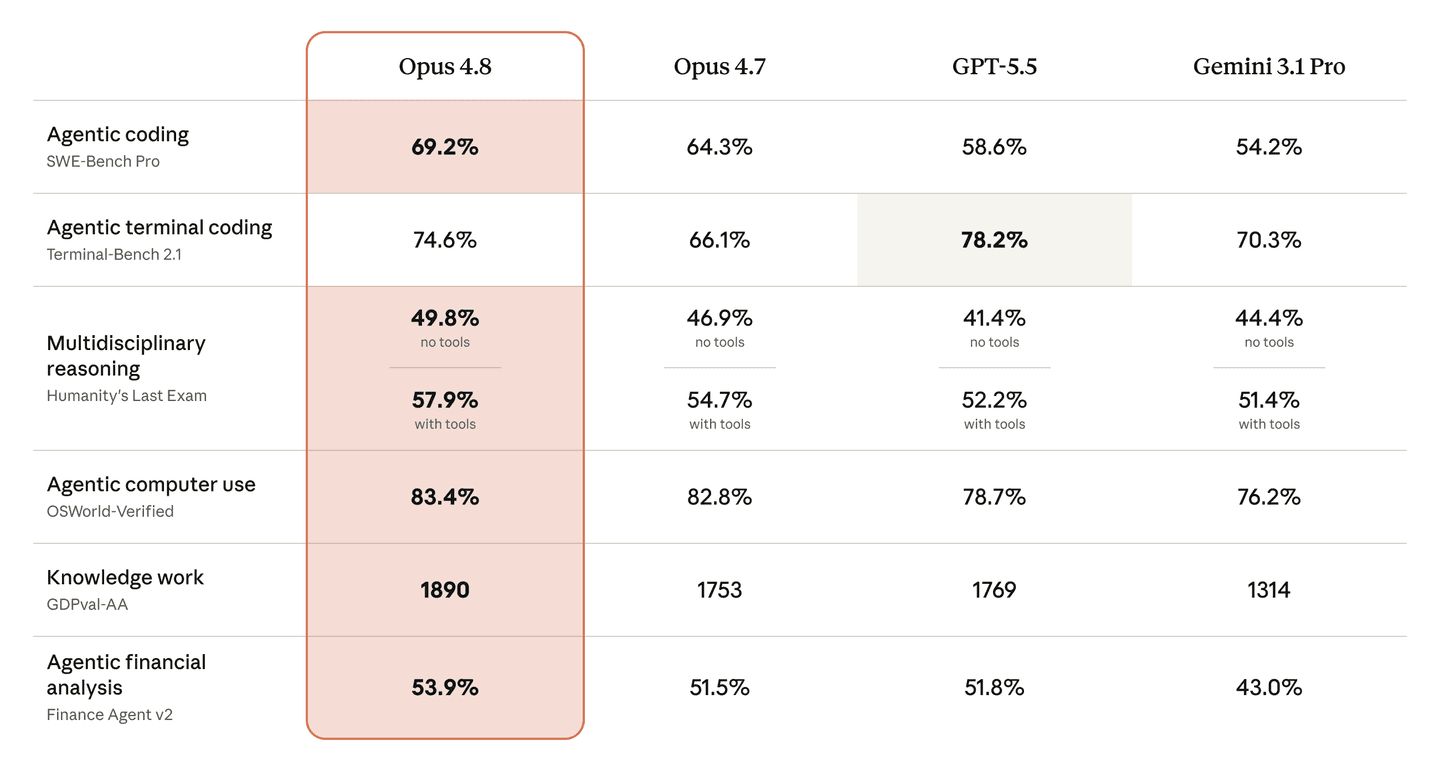
Anthropic compares Opus 4.8 with Opus 4.7, GPT-5.5 and Gemini 3.1 Pro across coding, computer use, reasoning and knowledge-work evaluations.
(Image source: Anthropic.)
The short version: Opus 4.8 is clearly stronger than 4.7 and often leads in the kinds of tasks that resemble real agent work rather than a single chatbot prompt.
The numbers worth remembering:
- SWE-Bench Pro: Opus 4.8 reaches 69.2%, up from 64.3% for Opus 4.7, ahead of GPT-5.5 at 58.6% and Gemini 3.1 Pro at 54.2%.
- Terminal-Bench 2.1: Opus 4.8 jumps from 66.1% to 74.6%, but GPT-5.5 leads in the table at 78.2%. Anthropic also notes that GPT-5.5 has a reported 83.4% score with the Codex CLI harness, so this is not a simple leaderboard story.
- Humanity's Last Exam: Opus 4.8 leads both without tools and with tools, at 49.8% and 57.9%.
- OSWorld-Verified: Opus 4.8 reaches 83.4%, a smaller but still meaningful lift over Opus 4.7.
- GDPval-AA: Opus 4.8 scores 1890, ahead of GPT-5.5 and well ahead of Gemini 3.1 Pro.
- Finance Agent v2: Opus 4.8 leads the table at 53.9%, though the margin over GPT-5.5 is modest.
This is not a model that crushes every category by a mile. It is a model that looks more even. In agentic work, consistency is often more valuable than one dramatic record.
The Most Important Improvement: It Knows When It Does Not Know
The most practical part of the announcement is about honesty. Anthropic says Opus 4.8 is about four times less likely than its predecessor to let flaws in its own code pass without comment.
That sounds less exciting than a new benchmark record, but for engineering teams it is more interesting. An agent that makes a mistake and says "something may be wrong here" is much easier to manage than one that confidently hands back a pull request full of hidden assumptions.
The same applies to analytical work. Early feedback highlighted by Anthropic repeats a clear pattern: Opus 4.8 is more likely to flag uncertainty, call out weak inputs and avoid claiming progress when the evidence is thin.
That is what many autonomous workflows have been missing. Not more confidence. Better self-checking.
Dynamic Workflows: Claude Code Moves Toward Orchestration
The biggest platform feature is dynamic workflows in Claude Code. In research preview, Claude can plan a larger task, run many subagents in parallel, verify their outputs and then report back to the user.
Anthropic gives the example of codebase-scale migrations across hundreds of thousands of lines, from kickoff to merge, using the existing test suite as the quality bar.
That is exactly where developer tools are heading: less "write this function" and more "take this change through the system and show me how you verified it."
It is still a preview, so it should not be treated as a blanket production promise. But the direction is obvious. AI coding is becoming less like chatting with one model and more like managing a small agent team with permissions, cost limits, tests and logs.
Effort, Cost and Real-World Use
Opus 4.8 defaults to high effort, which Anthropic sees as the best balance between quality and user experience. Harder tasks can use "extra" or xhigh in Claude Code, and also "max."
This is a healthy move because users finally get a more explicit slider between speed, quality and rate-limit usage. The catch is simple: more effort usually means more tokens. Even when base pricing stays the same, the real cost depends on how often you let the model think longer.
In practice:
- Simple fixes and quick answers do not need maximum effort.
- Long reviews, migrations, multi-step analysis and asynchronous work may justify
xhigh. - Fast mode can be valuable for interactive work, but it costs more than regular mode.
- Production agents should be measured by cost per completed task, not just price per million tokens.
Who Should Care Most
Three groups benefit most.
First, software teams using Claude Code or custom agents against large repositories. Here, code quality is only one part of the story. Planning, tool use, testing and knowing when to stop before a bad change matters just as much.
Second, companies building document-heavy agents for legal, finance, analysis, reporting, research and slide workflows. GDPval-AA and Finance Agent v2 suggest Opus 4.8 is strong where the output needs to be commercially useful, not merely articulate.
Third, teams whose workflows require a model to preserve style, context and judgment across a long session. If AI is going to work on the same project for an hour, "do not drift" becomes a premium feature.
What Still Needs Caution
Benchmarks are useful, but they are not production. Your repository, data, tests and prompts matter more than a launch table.
Some margins are also small. On OSWorld-Verified, Opus 4.8 is ahead of Opus 4.7, but not by a huge gap. On Finance Agent v2, the lead over GPT-5.5 is also narrow.
Dynamic workflows sound powerful, and that is exactly why they need guardrails: sandboxes, permissions, budgets, tests and logs. An agent that can launch hundreds of subagents needs mature infrastructure around it.
Bottom Line
Claude Opus 4.8 does not look like a fireworks release. That is a good thing. It is a more mature update: less about a model dazzling in one isolated task, more about trusting it with longer work and getting fewer silent surprises back.
For ordinary users, it should feel like a better Claude. For teams building agents, the more important signal is that a frontier model is starting to behave more like a collaborator that can say "let's check this again" before it makes a mess.